
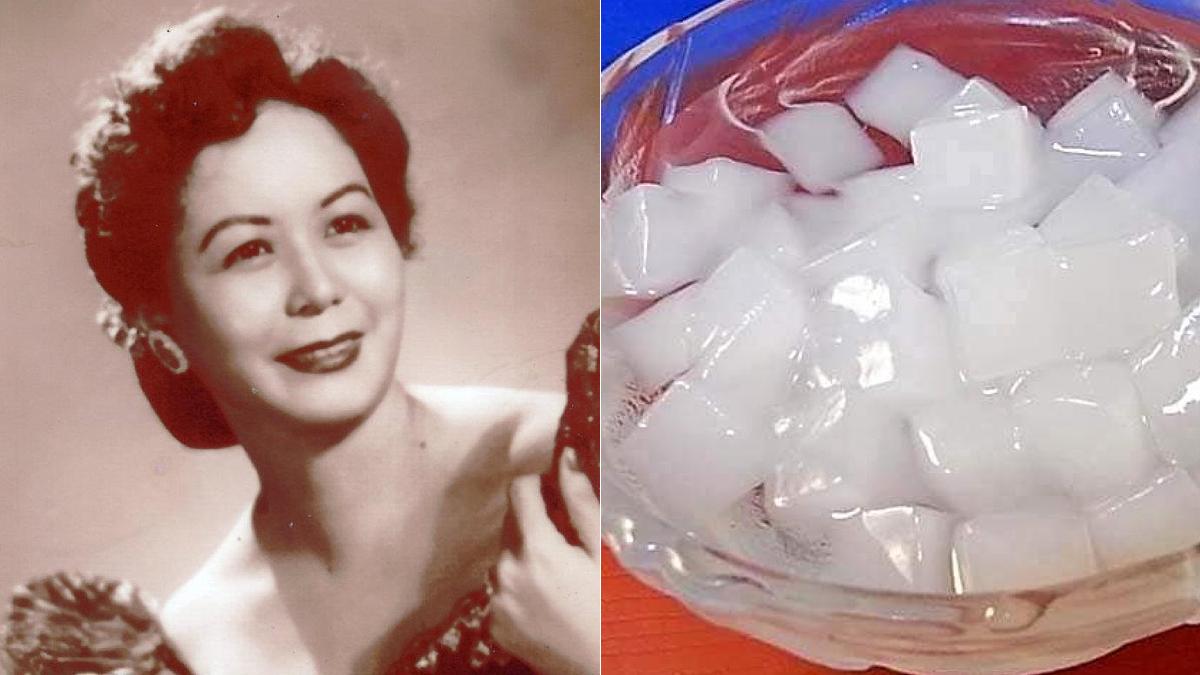

Ah yes, what would we do without our beloved nata de coco? It's arguably one of our most important delicacies, a very Filipino one at that.
We can find it in our candies, drinks, desserts (the thing that quietly binds halo-halo together in a way), and the like, across restaurants and street stalls all over the country.
Around the world, nata de coco has become one heck of a treat.
To us, it almost feels like an afterthought, considering how much we take it for granted. But nata de coco is something we can all quietly be proud of.
Read:
How much does it cost to install home elevators?
Ynna Asistio meets ex-boyfriend Mark Herras and his wife 10 years after breakup
Angelica Panganiban surprised with bridal shower ahead of her beach wedding
IS NATA DE COCO FROM THE PHILIPPINES?
Yes, it's actually a Filipino invention, made for Filipinos' consumption.
And the woman behind it is none other Lipa, Batangas-born chemist Teódula Kalaw África.
Back in 1949, Africa, who was working as a chemist for the Philippine National Coconut Corporation (now, the Philippine Coconut Authority), came up with the ingenious idea to take advantage of the humble coconut, which proved to be an interesting alternative to pineapple, a fruit that had always been in vogue in Philippine cuisine since the 18th century.
At the time, pineapple was commonplace in Filipino treats, most notably for nata de pina.
The potential of coconuts hadn't been exploited as much. Africa made the most out of leftover coconut water or coconut "waste."
This led to the creation of nata de coco (or coconut gel, for the rest of the world).
WHAT ARE NATA DE COCO MADE OF?
Nata de coco is a dietary fiber that undergoes a careful fermentation process. It is produced by mixing boiled coconut water with sugar, ZA, and acidic acid. It is then mixed with Acetobacter xylinum, and fermented for seven or more days.
From there, it moves on to further processing. The delicacy is about 96 percent water and 4 percent fiber. Of course, mass production takes a little longer.
A photo of Teodora Kalaw Africa from back in the day.

ALSO READ:
This Filipina Artist Was Away Ahead of Yayoi Kusama's Cosmic Circles
A Filipino Scientist Discovered a New Cockroach. He Named It After a Pokemon
Commercial production for nata de coco would begin five years after Africa's discovery.
By the '70s, its production was optimized and has since become a major export.
It became popular in Japan in the '90s, as well. This would carry over to the entirety of Southeast Asia and the rest of the world.
Today, the Philippines, Malaysia, and Indonesia have emerged as the delicacy's top producers.
Sadly, not much is known about Teodora Kalaw Africa herself. What we do know is that she hails from Lipa and was a chemist who graduated from the University of Santo Tomas.
Unfortunately, she came from a period where women in science weren't exactly recognized, especially in a country as conservative as the Philippines.
In the National Academy of Science and Technology registry published in 1999, she was only unfortunately referred to as "T.K. Africa."
Nevertheless, she has quietly left one of the most enduring symbols in our culture in many ways.
Nata de coco was never patented or anything, too, which is a shame if we think about it.
It had so much potential when it was first developed, and the Philippines certainly could've reaped more rewards.
As for Africa, she should, at the very least, be remembered as one of the country's great food scientists for giving the Philippines, and the world, nata de coco.