

On September 7, 2025, around 80,000 people gathered to witness the canonization of Carlo Acutis—the first Millennial to be declared a saint by the Catholic Church.
The solemn yet widely publicized ceremony was held in St. Peter’s Square, Vatican City, where Pope Leo XIV presided over a special open-air Mass.
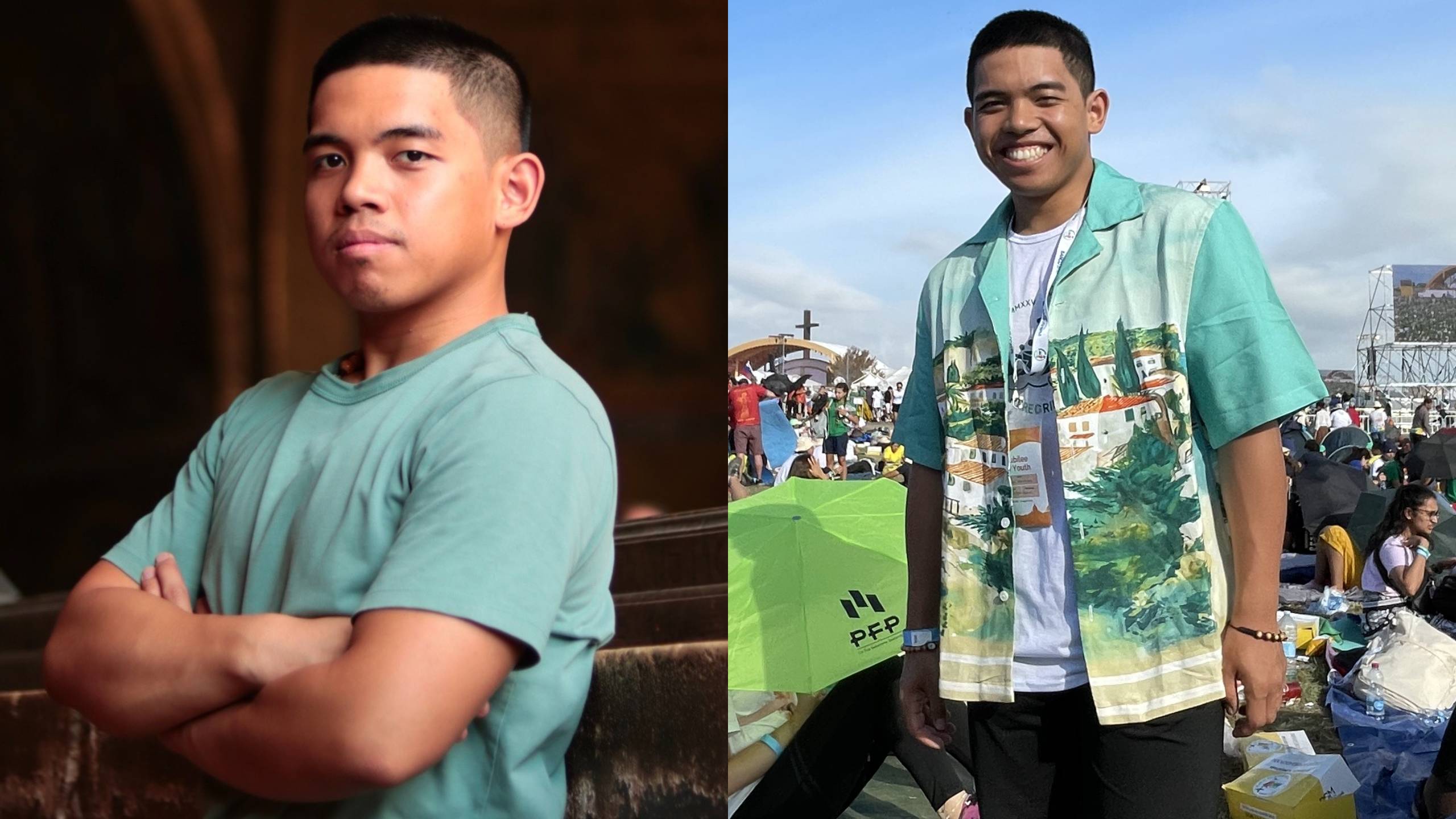
Among those in attendance was Nicholas Brando Mendoza, a young Filipino graphic and motion designer who traveled with his family from Dubai to Rome to witness the historic event.
Read: Carlo Acutis to be declared a saint in September 2025
Brando’s trip to Vatican City was special in its own right. He earned the opportunity after winning an art competition organized by Truthly, a Catholic AI app founded in 2024 in Charlotte, USA, in collaboration with the production house Lux Lab.
“I first learned about the contest through word of mouth from friends who were with me during my pilgrimage to the Jubilee of Youth,” Brando told PEP.ph (Philippine Entertainment Portal).
“They knew about my work in faith-inspired design, so they shared it with me because it reminded them of me.”
Interestingly, Brando entered the competition hoping to win a chance to attend the canonization of Pier Giorgio Frassati, his favorite saint, who was recognized alongside Carlo Acutis.
Like Carlo, Pier was also of Italian descent and died young at the age of 24 because of polio.
GETTING TO KNOW CARLO ACUTIS
The art competition, however, focused specifically on Carlo and the inspiration drawn from his life.
Carlo, who died of leukemia at just 15 on October 12, 2006, used the internet to share the teachings of the Catholic Church.
He built websites for his parish and local community, including one that documented Eucharistic miracles from around the world.
The competition asked participants to submit original artworks, such as paintings, drawings, or digital designs, that pay tribute to Carlo, with the winning design to be featured on a T-shirt.
Designs could be created using either traditional techniques or digital tools.
Although the contest was sponsored by an AI app, the use of AI in creating the designs was not permitted.
“The goal was not only to captivate people but also to inspire curiosity about the life of St. Carlo Acutis,” said Brando about his design objective.
“Ideally, this curiosity could lead to conversations with the person wearing it, creating an opportunity for evangelization.”
Part of the process, of course, was for Brando to learn more about Carlo’s life and journey to sainthood.
“The more I learned about him, the more I could design a piece that reflected his spirit. This was the ‘gold-digging’ stage—looking for insights or meaningful details that could be cleverly expressed visually,” he remarked.
Before beginning his research, Brando had only a limited understanding of his subject, relying mostly on what he had heard and his general impressions of Carlo’s personality.
“Yes, I had heard of Carlo Acutis before, but I only knew what he was known for—that he was a tech-savvy kid who enjoyed video games and Pokémon,” said Brando, 23, who holds a Graphic Design degree from Middlesex University Dubai.
“Other than that, I didn’t have a devotion to him until recently.”
Read: From curving ice to sculpting saints: Meet the man behind the viral Blessed Carlo Acutis statue
Was there anything about Carlo’s characteristics that amazed him the most?
“What surprised me most was how normal he was,” replied Brando.
“He wasn’t distant or overly pious in a way that felt unreachable. He was extremely relatable, which I believe is why a lot of young people today are so attracted to him.”
CREATING HIS WINNING DESIGN
Equipped with all this information, Brando proceeded to sketch ideas and pick an illustration style that suited his vision for the project.
“Once I was satisfied with the quantity, not necessarily the quality, of sketches, I moved to executing the final design using Adobe Illustrator,” Brando said.
He described the process as laborious, having to design each line of the illustration, particularly sketching the faces of other saints beneath Carlo’s image.
“The design is meant to resemble the background painting of an altar in Italy. If you visit or research St. Peter’s Basilica, you’ll notice the altar paintings are often rectangular with rounded tops,” described Brando.
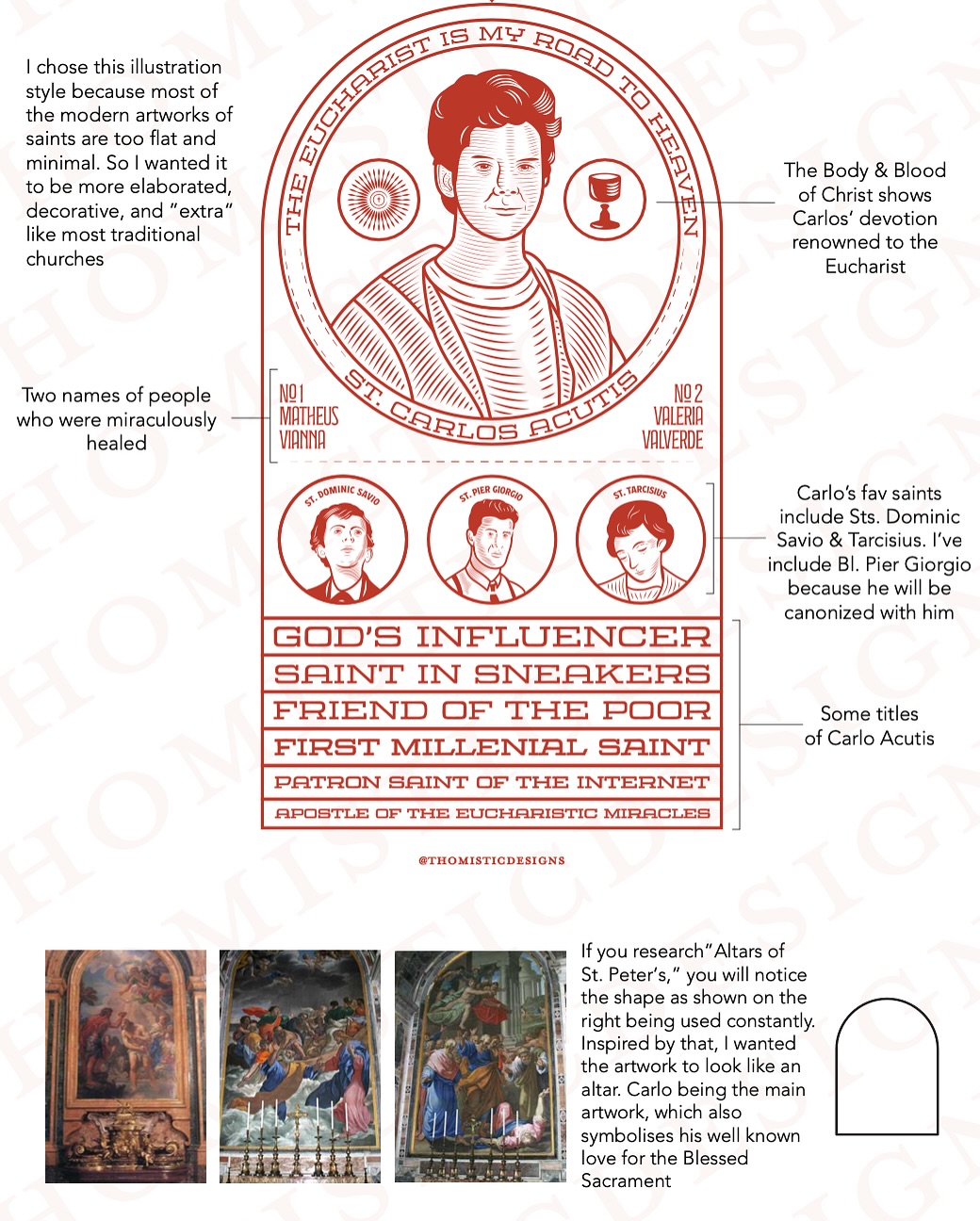
“I wanted to highlight Carlo Acutis’ love for the Eucharist by making the design resemble an altar backdrop.
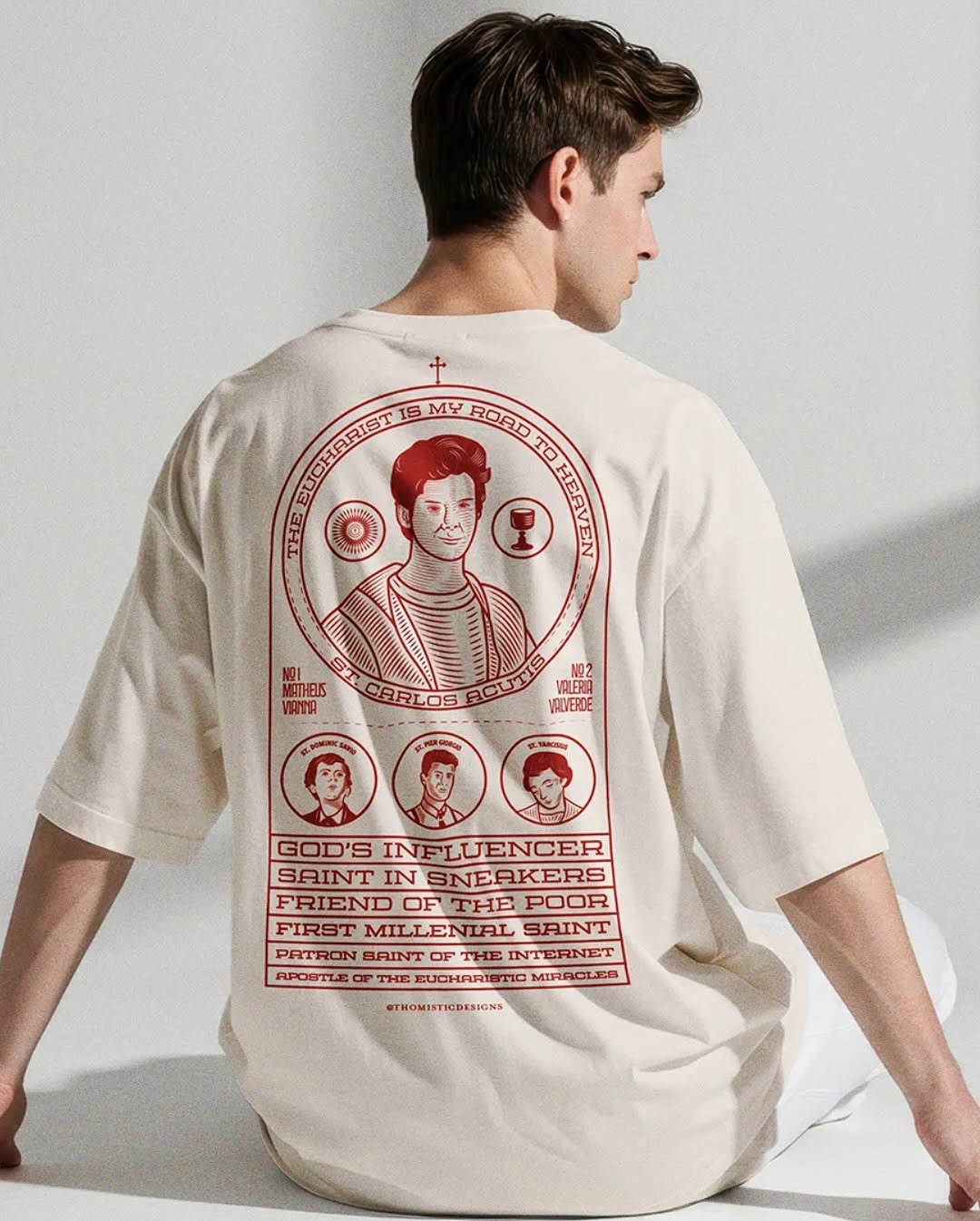
“The back of the shirt emphasizes his love for the Eucharist and his desire to share the Good News with everyone."
Even the text was well thought of.
“On the front, I used the phrase ‘Level Up (to Sainthood)’ — a subtle nod to his love of video games.”

FLYING TO ROME TO WITNESS THE CANONIZATION
A few weeks after submitting his entry, Brando received an email from the organizers requesting a video call.
“The message didn’t explicitly say that I’d won, but since they requested an online meeting over the weekend, I took it as a good sign that my design was being seriously considered,” he recalled.
Sure enough, he was informed during the call that his design had won over the other participants.
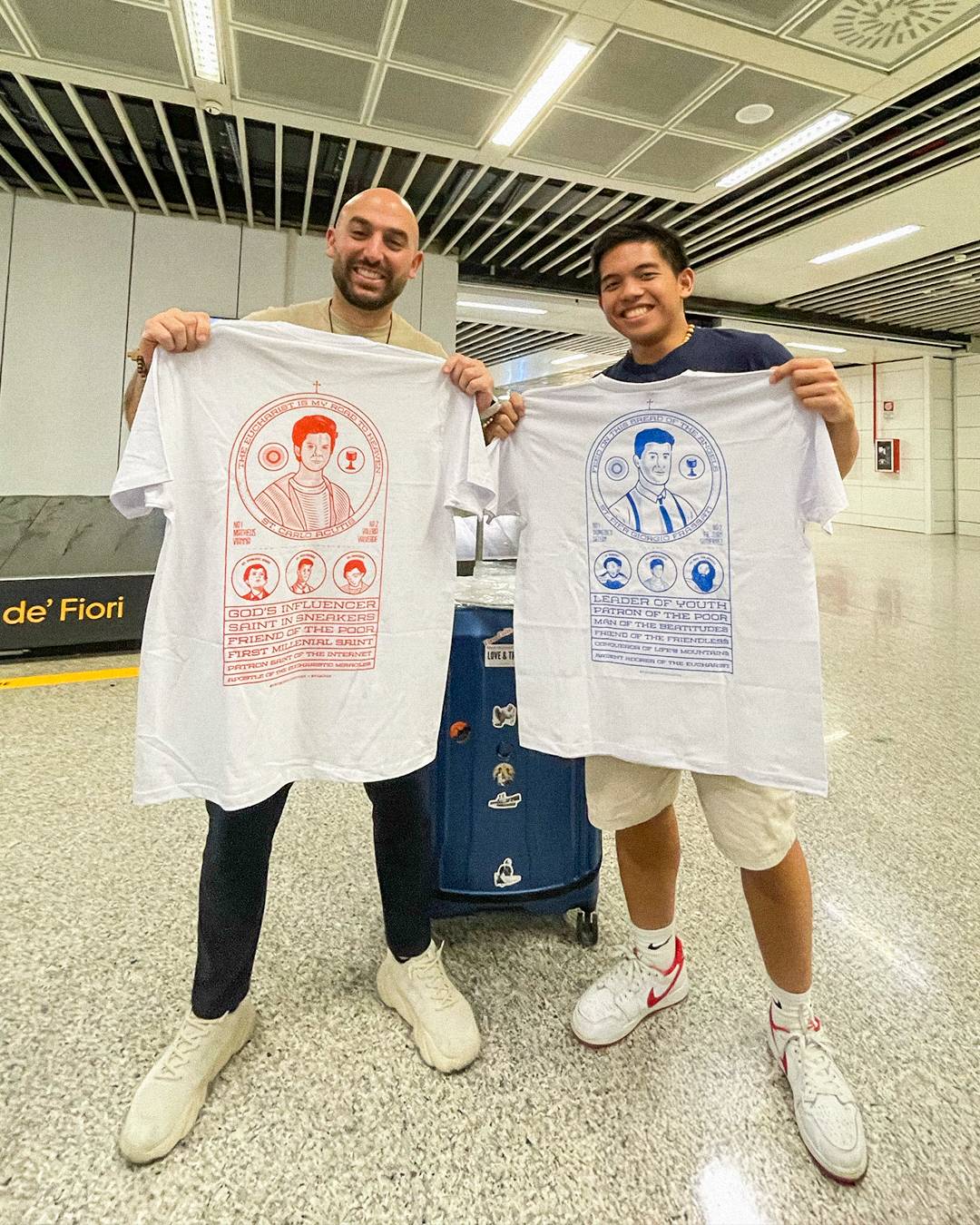
“The main prize was the honor of having my design printed and sold through Truthly.ai, which also gave Thomistic Designs, my design page where Christians can see and understand our faith through the lens of design, valuable exposure,” he said.
“But the biggest prize was two tickets to Rome to attend the canonization of Carlo Acutis.”
Brando’s winning artwork became the design for a limited-edition T-shirt release.
The Vatican trip was Brando’s second visit, having toured the city in August that same year as part of a pilgrimage organized by the diocese in the United Arab Emirates.
He described witnessing the canonization as fascinating and a “spiritually nourishing experience,” made more special as he was with his parents and sister.
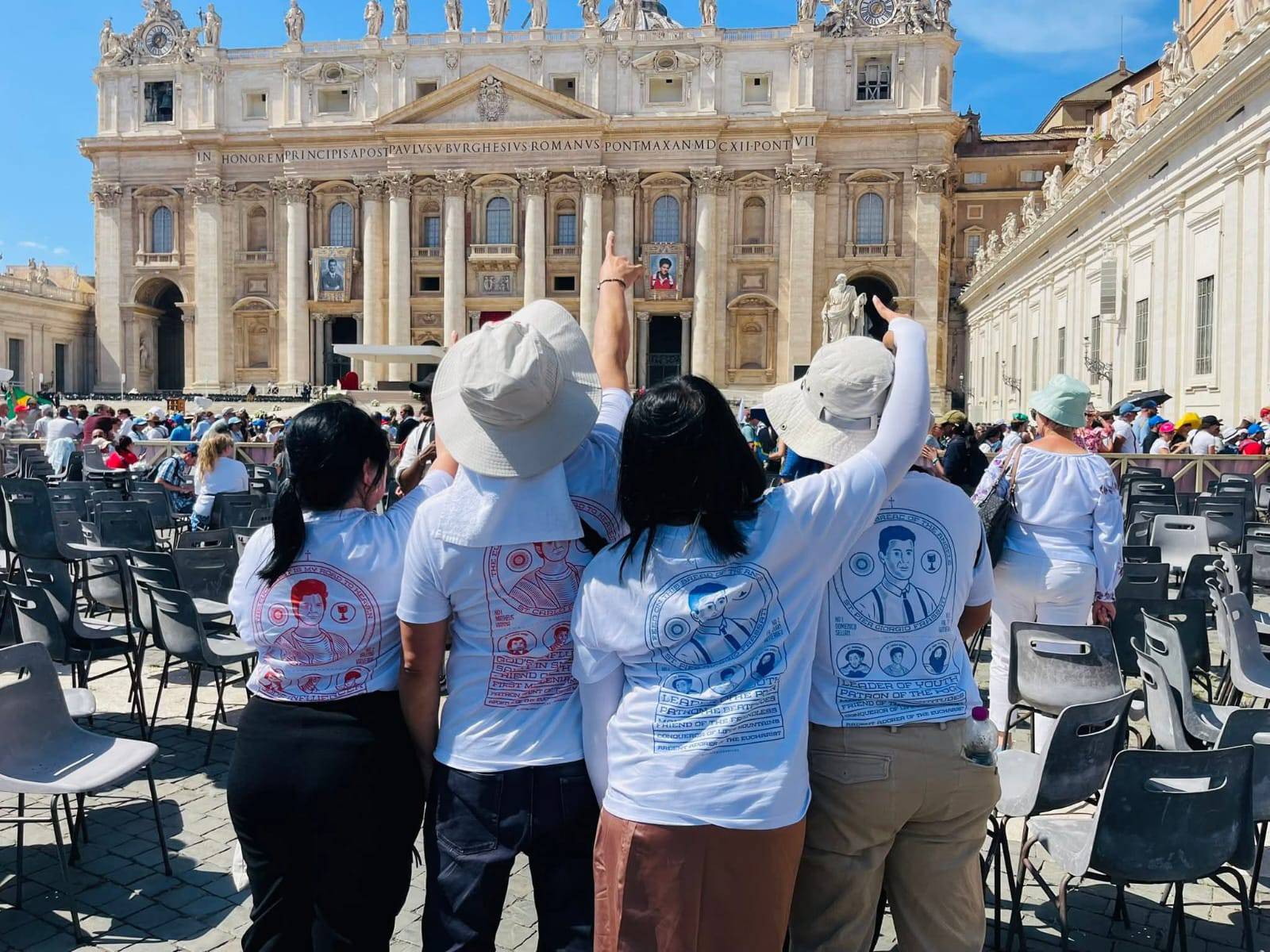
“I had never attended or even watched a canonization before, and it was moving to witness two young men [Carlo Acutis and Pier Giorgio Frassati] become saints – both shining examples of our faith,” Brando reflected.
“Moreover, I think what made this experience interesting was that the members of Carlo and Pier’s family were there. Even one of the lectors was Carlo’s younger brother.”
Brando realized that being a good person doesn’t depend on one’s status, age, or religious affiliation, and can be reflected even in the simplest deeds and gestures.
“When we think of saints, we often imagine people who lived 500 years ago or those who were priests or nuns,” mused Brando.
“But Carlo showed that holiness can be found in everyday life—in the ordinary duties and joys of our day-to-day living.”