

One good thing to come out of this coronavirus pandemic is the show of bravery and heroism by ordinary people.
They are right here with us, and they have always been around.
From healthcare frontliners to supermarket staff, from police personnel to garbage disposal workers, from farmers to food-delivery drivers, the crisis has proven that there is no shortage of men and women who are our real-life heroes.
These men and women say they are simply doing their jobs. But, it is their jobs that keep the rest of us alive and, what is more, can end up killing them.
One person who deserves the honor of being called a hero is Dr. Abundio Balgos.
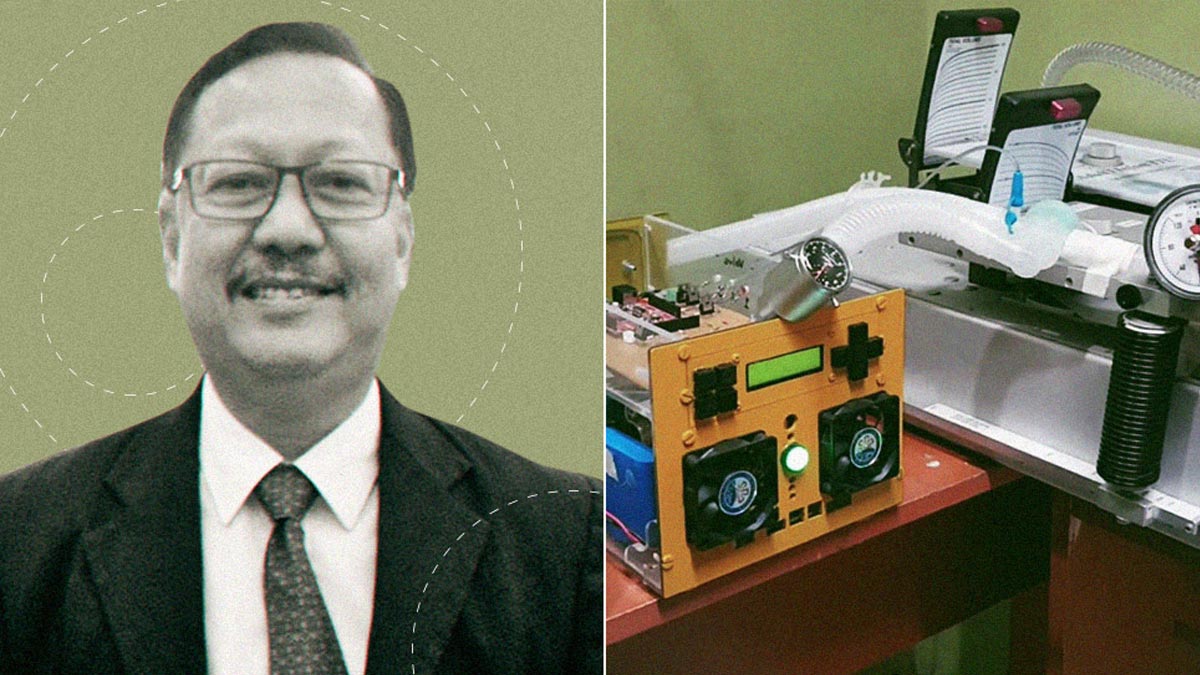
A pulmonologist and retired professor of the University of Philippines College of Medicine, Dr. Balgos has led a team of experts in the development of ReliefVent, a locally made, low-cost, high-quality ventilator.
Better known as Ginhawa, the ventilator will soon help those who are severely ill from COVID-19.
Ginhawa, it will interest others to know, means relief in Pilipino.
At least 50 percent of patients in the intensive care unit need a ventilator, according to the Philippine Council for Health Research and Development (PCHRD) of the Department of Science.
"In many developing countries like the Philippines," explains the PCHRD, "there is only one ventilator per 10 ICU beds, which may result in unwanted increase in mortality rates."
Small hospitals are especially disadvantaged.
Says the PCHRD, "The prohibitive cost of acquiring a ventilator plus the inaccessibility of spare parts when a ventilator breaks down poses a challenge for small hospitals to acquire more units."
Enter Dr. Balgos and his team.
It is a strong team: Dr. Camilo Roa Jr., biomed tech specialist Glenn Tuazon, the Philippine General Hospital pulmonary fellows, the University of Philippines Manila administration, and software and hardware specialists.
The team's creation, Ginhawa, can be used for both children and adults, and is projected to cost 40 percent lower than other portable ventilators in the market.
According to the J. Amado Araneta Foundation—which has named Dr. Balgos a Living Hero in its Innovators Series—the project initially went to the backburner when the doctor became busy with his academic work and clinical practice.
In 2012, Dr. Balgos and the team finally received funding, through PCHRD Chair Dr. Jaime Montoya, to follow-through with the project.
This started the slow but progressive development of Ginhawa, for which the team had already conducted human-safety studies in 2017.
Ginhawa is currently in the production of the final three prototypes, prior to field- testing of 30 ventilators in five hospitals.
The ventilator has the functions of controlled ventilation, assist-control ventilation, and synchronous intermittent mandatory ventilation.
During this time of the coronavirus pandemic, ventilators have become crucial medical determinants for gravely affected patients.
Presently, there is a shortage of ventilators.
"At the outset of the project," says Dr. Balgos, "we already told the government authorities that we not only lack ventilators for our usual patients who go into respiratory failure.
"The experience with the SARS, Ebola, H1N1, and MERSCOV epidemics made us realize that we have to be more ready and self-sufficient if another outbreak happens, which is what we have now.
"There are only approximately 1,500 working ventilators in the whole country, and if we get hit like China, Italy, and the U.S., we need more than 1,500 more ventilators."
Dr. Balgos is also actively collaborating with a group of materials engineers, studying the best methods for the sterilization and the safe recycling of N95 and surgical masks, in the face of dwindling supplies and increasing need.
Dr. Balgos runs The Health Centrum Hospital in Roxas City, Capiz.
The J. Amado Araneta Foundation's Living Heroes Innovators Series pays tribute to trailblazers, pathfinders, and prime movers in this time of COVID-19 pandemic, and hopes "to share inspiring stories of heroes to Filipinos and the world."